
Material Identification with Hyperspectral Imaging in the RAPTOR System
Conveyor belt systems are crucial in many modern industry applications. From recycling to manufacturing and food processing, they move, sort, and inspect materials at high speed, replacing heavy manual effort with continuous, reliable throughput. In the ReSoURCE project, we are taking this a step further: adding advanced sensing so that sorting isn’t just about size or shape, it’s about the identification of material composition.
At the heart of this capability is hyperspectral imaging (HSI). Unlike conventional RGB cameras that record three broad colour channels, HSI captures hundreds of narrow spectral bands across the visible, near-infrared (VNIR), and short-wave infrared (SWIR) ranges. Each material reflects light in a characteristic way, its so-called spectral fingerprint, allowing for a precise, fast identification directly on a moving belt.
We have previously shared the laboratory groundwork behind this approach, i.e. sensor characterisation, algorithm tuning, and material libraries. You can find out more in posts such as NEO visit in Leoben in October 2023, Predicting Refractory Brick Types with our HySpex VNIR-SWIR Cameras, Shining a Light on Raw Materials, and Our Samples in the Light of Science. With that foundation in place, this article focuses on bringing HSI from laboratory to real-world application inside the RAPTOR system.
NEO, HySpex, and the Technology behind HSI
Based in Norway, Norsk Elektro Optikk (NEO) has developed optical instruments for more than four decades. Through our HySpex division, we design and manufacture high-performance hyperspectral cameras trusted by researchers and industry worldwide. HySpex systems are known for high spectral and spatial resolution, low noise, and excellent optical quality, delivered in robust platforms that operate reliably in the lab, in the field, on aircraft, and in industrial applications.
This versatility is why HySpex cameras are used across industrial monitoring, system development, and research, reaching from geoscience and environmental mapping to quality control in manufacturing and advanced materials analysis. Beyond ReSoURCE, NEO contributes to initiatives like M4Mining, where hyperspectral imaging supports responsible mineral exploration and resource characterisation.
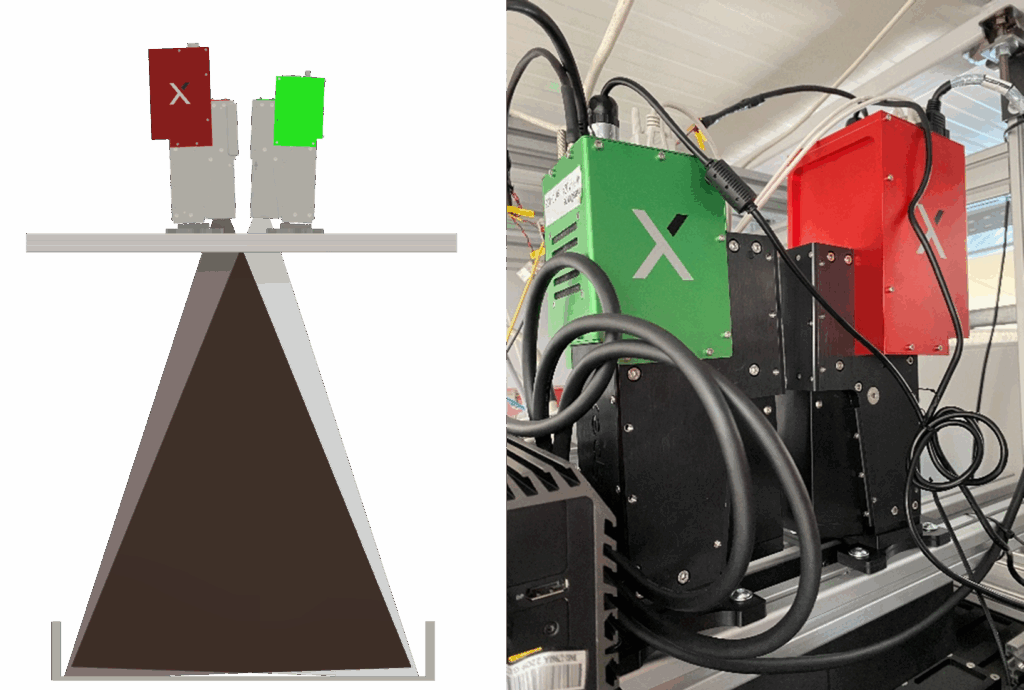
Figure 1. Hyperspectral cameras on Demonstrator A. Left: diagram used for designing the module. Right: Cameras installed onsite. The red camera is a HySpex SWIR 384, and the green one a HySpex Baldur 1024 N.
NEO’s Role in ReSoURCE
Within ReSoURCE, NEO provides both equipment and expertise. The RAPTOR sorting line integrates two HySpex cameras, a Baldur VNIR V-1024N and a Classic SWIR-384, together covering the wavelength range of 400–2500 nm. Our team also contributes geological insight and chemometrics know-how, ensuring that spectral data translates into dependable, application-ready material classes on the conveyor (read more about NEO´s role in this project).
From Calibration to Classification – HSI on the RAPTOR Conveyor
Moving from the lab to the line starts with a simple but crucial step: reflectance calibration. Before measuring sorting material, the system records a calibrated white reference image. This enables accurate conversion of raw sensor data into absolute reflectance, which is essential for stable modelling and inference.
Once running, the belt is scanned continuously. The chemometrics software Breeze (Prediktera) converts the incoming image stream into reflectance and performs automatic segmentation, removing the background so that only the material particles remain. For the current use case, the analysis targets particle sizes between 20 and 120 mm. Each detected fragment is then classified according to its spectral fingerprint.
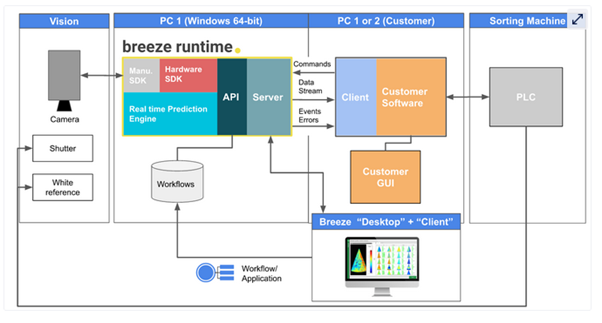
Figure 2. Integration schematics for HS camera, Breeze analysis SW and third-party SW for controlling or receiving results from the analysis process. In Demonstrator A, there are 2 “Clients”: the general DA interface and the ROI module
To ensure consistent, uniform illumination across both cameras’ fields of view, the HSI setup uses four 150 W halogen lamps aimed at a narrow common area on the conveyor. The lighting assembly is mounted beneath the measurement bridge for thermal isolation and is encapsulated to withstand dust generated by the material stream. This combination stabilises the radiometric conditions and improves repeatability in a real industrial environment.
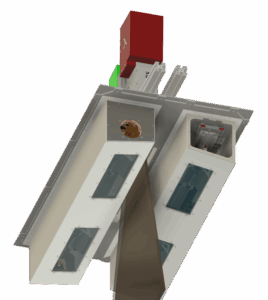
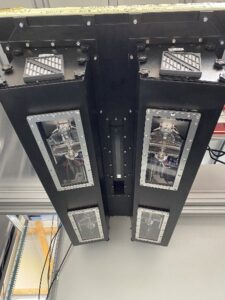
Figure3. Custom illumination system consisting of 4 halogen, broadband lamps. Left: diagram used for design and integration. Right: lamps installed on Demonstrator A.
Sensor Fusion: HSI + 3D Recognition + LIBS
RAPTOR is built around sensor fusion, combining complementary strengths for reliable, in-line decisions:
- HSI identifies material classes from spectral fingerprints in real time.
- A 3D recognition module captures the XY position and geometry of each particle on the belt, ensuring every object can be tracked and addressed precisely.
- The LIBS (Laser-Induced Breakdown Spectroscopy) unit receives both the object’s position and the HSI-predicted class. By firing a brief laser pulse and analysing the resulting plasma emission, LIBS provides elemental confirmation of the material, closing the loop between spectral prediction and chemical verification.
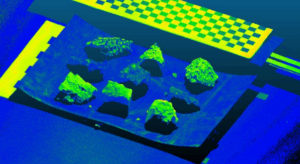
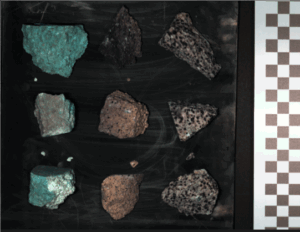
Figure 4. RGB picture of refractory samples (right) and a corresponding 3D image generated using a laser profiler (left).
General Characteristics of the Instrument – Built for Real-World Use
HySpex cameras in the RAPTOR combine fine spectral sampling (VNIR + SWIR) with high spatial fidelity and stable radiometry, which is critical for conveyor-based analytics. The optics are designed to minimise aberrations, the detectors offer excellent signal-to-noise performance, and the systems integrate neatly with other industrial software and hardware. In practice, that means consistent measurements, robust operation, and data you can model on. Whether you’re developing algorithms, running pilot lines, or deploying at scale.
Applications Across Industry, Development, and Research
Because HSI recognises material composition rather than appearance alone, the same core instrument supports many domains:
- Industrial: in-line sorting, quality assurance, process monitoring, and automated decision support.
- Development: rapid prototyping of new sorting strategies, material library expansion, and model transfer from lab to line.
- Research: geological mapping, environmental monitoring, precision agriculture, and materials science, often feeding insights back into industrial practice.
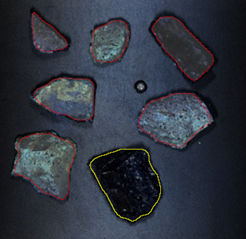
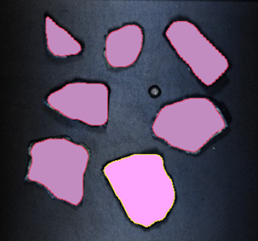

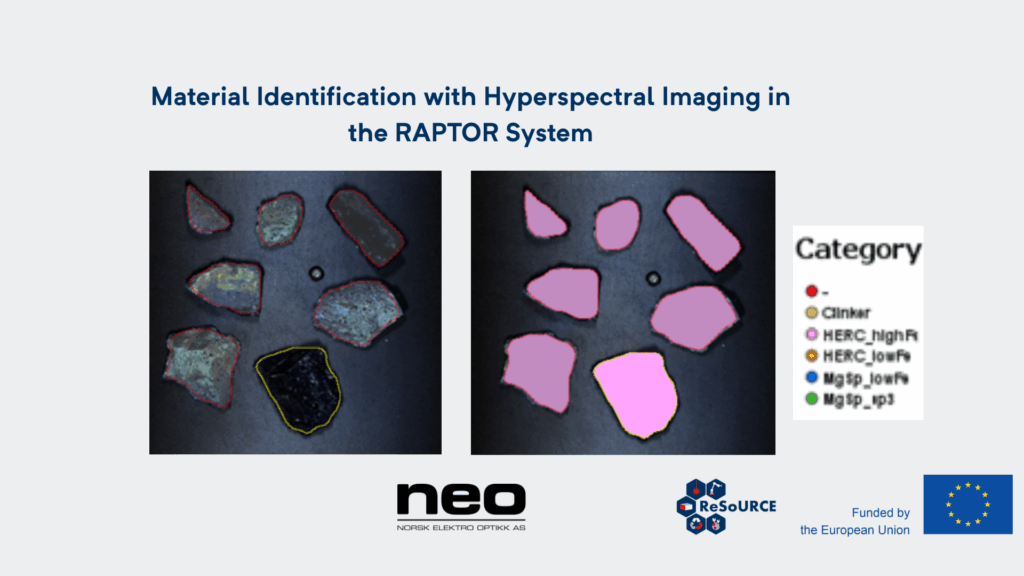
Figure 5. Left: SWIR image with segmented samples of material class HERC_highFe. Right: ground truth category displayed as an overlayed mask.
Looking Ahead
What makes RAPTOR compelling is not just the technology, but the impact: a practical path to sorting by composition at conveyor speeds. By combining HySpex hyperspectral imaging with 3D recognition and LIBS verification, the ReSoURCE project shows how advanced sensing can make recycling more efficient, more accurate, and more sustainable.
For NEO, it’s a natural extension of what we do: delivering precise, reliable measurements and the expertise to turn them into working solutions, on the factory floor as well as in the field.

Author’s Portraits
Justus Constantin Hildebrand
Justus Constantin works at HySpex by Norsk Elektro Optikk AS as a Hyperspectral Application Eng
Justus Constantin Hildebrand works at HySpex by Norsk Elektro Optikk AS as a Hyperspectral Application Engineer. HySpex is the industry-leading brand for airborne and ground-based hyperspectral imaging and a manufacturer of advanced electro-optical instruments.
He holds a background in Geography and Remote Sensing, having earned his Bachelor’s and Master’s degrees at Freie Universität Berlin and Humboldt Universität zu Berlin. During his studies, he worked extensively with hyperspectral cameras at the GeoForschungsZentrum Potsdam (GFZ), where his interest in the field deepened. In September 2023, he joined HySpex in Oslo, where he continues to work within the hyperspectral imaging domain.
At HySpex, Justus is involved in a wide range of industrial projects and applications, contributing his expertise across different sectors, including his participation in the Resource project.
ineer. HySpex is the industry-leading brand for airborne and ground-based hyperspectral imaging and a manufacturer of advanced electro-optical instruments.
He holds a background in Geography and Remote Sensing, having earned his Bachelor’s and Master’s degrees at Freie Universität Berlin and Humboldt Universität zu Berlin. During his studies, he worked extensively with hyperspectral cameras at the GeoForschungsZentrum Potsdam (GFZ), where his interest in the field deepened. In September 2023, he joined HySpex in Oslo, where he continues to work within the hyperspectral imaging domain.
At HySpex, Justus is involved in a wide range of industrial projects and applications, contributing his expertise across different sectors, including his participation in the Resource project.
Partner